
Preparation of fungi for DNA extraction typically involves growing cultures in liquid culture in Erlenmeyer flasks, Roux bottles or even microfuge tubes (Cenis 1992 Nucl. Acids Res. 20:2380). Growing fungal cultures in liquid may require formulating new media or determining aeration requirements, and there are no rapid means of confirming the identification of the resulting mycelium. Fungi are grown routinely on agar media for identification, but agar complicates DNA extraction.
Solutions of ''reverse agar'' (BASF pluronic polyol F-127), a block polymer of polyoxypropylene and polyoxyethylene, are solid at normal room temperatures, but liquid at 4C. When the compound is used as a replacement for agar in solid media, its unusual properties allow the separation of mycelium and medium by simply placing a mature culture in a refrigerator. The compound has been employed for isolation of heat sensitive antagonistic microorganisms (Gardner and Jones 1984, J. Gen. Microbiol. 130:731-733; Olson and Lange 1989 Opera Bot. 100:197-199), isolation of enzymes associated with basidiome formation in Coprinus (Choi and Ross 1988 Exp. Mycol. 12:80-83), and for isolating mycelium from Neurospora race tubes (Munkres 1990, Fungal Genet. Newsl. 37:26). In this note, the possibility of extracting DNA suitable for PCR amplification from mycelium grown on reverse agar media is documented.
''Reverse Malt Agar'' (RMA) medium was prepared containing 30 BASF pluronic polyol F-127 substituted for agar in the Malt Extract Agar medium of Pitt (1979 The Genus Penicillium, Academic Press). The liquid was poured over the F-127 granules and the resulting suspension left in the refrigerator overnight until dissolved. The solution was then autoclaved, resulting in a thick, sludge like substance, which was again refrigerated, until a homogenous, liquid solution resulted. The liquid was then poured into petri dishes, where it solidified as it warmed to room temperature. The resulting medium is not a true solid, but rather a dense gel.
Cultures of Penicillium spinulosum Thom. (DAOM 216698), Aspergillus japonicus Saito var. japonicus (DAOM 216695), Gliocladium roseum Bainier (Doyle SB-03a, not saved) and Trichoderma harzianum Rifai (DAOM 216501) were grown on RMA for 7 days at 25C in 6 cm petri dishes. Growth rates were slightly slower than on the same medium made with 2 agar, but the resulting colonies produced microscopically typical sporulating structures. For DNA extraction, the petri dishes were placed in the refrigerator for approximately 1 hour until the medium had liquified. Subsequent handling was done on ice. Mycelium was lifted from the medium using an autoclaved pipette tip, placed on the inverted, slanted lid, and allowed to drain for 30-60 seconds. The mycelium was then cut into smaller pieces using a sterile scalpel blade, and transferred into autoclaved 1.5 ml microfuge tubes. The tubes were then spun in a cold microfuge for 5-10 minutes and the excess medium removed. The mycelium was washed twice with 750 uL cold, autoclaved distilled water followed by cold centrifugation, and then used directly for DNA extraction. The DNA miniprep method of Edwards et al. (1991 Nucl. Acids Res. 19:1349), modified by the addition of a cold 70 ethanol wash of the final pellet, was used. The resulting DNA was treated with RNAase A for 1 hour at 37C. PCR amplification of the ITS1-ITS4 region of the ribosomal DNA was performed using the primers and conditions given by White et al. (pp. 282-287 In: PCR Protocols, Innis et al. eds Academic Press). The resulting products were digested for 2 hrs at 37C using HinfI in the buffer supplied with the enzyme.
The DNA yields obtained from mycelium grown on RMA were similar to those obtained from mycelium grown in liquid culture. Washing away excess reverse agar with cold water significantly improved yields, but DNA also was isolated from unwashed mycelium. The resulting DNA performed normally in the ITS PCR amplification and subsequent restriction digests (Figure 1).
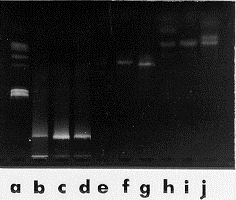
Figure 1. Miniprep DNA (b-d), ITS 1-4 amplification (e-g) and HinfI restriction digests (h-j) from fungi grown on malt extract reverse agar. b, e, h Penicillium spinulosum. c, f, i Aspergillus japonicus var. japonicus. d, g, j Trichoderma harzianum. Lane a is the marker.
Use of reverse agar for cultivation of fungi for DNA extraction may be convenient for certain studies. For fungi that do not produce characteristic structures in liquid broth, reverse agar provides a means of ensuring the correct identity of the mycelium before DNA extraction proceeds. Certain population genetics studies, for example, require the manipulation of a large number of cultures that must be cloned (eg. single-spore isolations) before genetic analysis can proceed. The use of reverse agar could eliminate one round of culture transfers, resulting in significant labour savings.
Reverse agar solutions can be stored for some time at 4C and plates poured when required. Experience has shown that poured plates do not keep indefinitely at room temperature. After 4-6 weeks, the medium no longer liquifies, presumably because of higher polymer concentrations resulting from water evaporation. Also, because the polymer itself is slightly inhibitory to fungi, it does not seem to be suitable for weak nutrient media. Our trials with the Fusarium medium SNA (Nirenberg 1981 Can. J. Bot. 59:1599-1609), for example, resulted in sparse growth that could not be harvested following liquification of the medium.
Acknowledgements: I am grateful to Dr. John Speakman (BASF, Limburghof, Germany) and BASF Performance Chemicals, Parsippany, NJ for providing samples of pluronic polyol F-127.
Note from FGSC: Dr. K.D. Munkres donated a large quantity of pluronic F-127 to the stock center. We will gladly make samples (100-200 g) available available at no cost to interested researchers.
1812年,法國皇帝拿破侖一世從俄羅斯莫斯科撤退時,其大部分軍隊因饑餓、疾病和寒冷的冬天而損失殆盡。如今,對這撤退途中喪生的30萬士兵的部分遺骸的DNA的分析發現,兩種未曾預料到的細菌性疾病很可能增加......
1812年夏,法蘭西皇帝拿破侖·波拿巴率50萬大軍入侵俄羅斯帝國。然而到12月時,這支軍隊僅余零星殘部。歷史記載將此次“全軍覆沒”歸因于饑寒交迫與斑疹傷寒。但一項新研究表示,從士兵牙齒中提取的DNA,......
美國北卡羅來納大學研究團隊研發出一種名為“DNA花朵”的微型機器人。這種機器人具有獨特的自適應環境變化能力,能夠像生物體一樣,根據周圍環境改變形狀和行為。“DNA花朵”機器人由DNA與無機材料結合形成......
瑞士蘇黎世聯邦理工學院科學家在最新一期《自然》雜志上發表論文稱,他們開發出一款名為MetaGraph的DNA搜索引擎,能快速、高效地檢索公共生物學數據庫中的海量信息,為研究生命科學提供了強大的專業工具......
究竟是什么讓人腦與眾不同?美國加州大學圣迭戈分校研究團隊發現了一個名為HAR123的小型DNA片段,這將是解開人類大腦獨特性之謎的關鍵。相關研究成果發表于新一期《科學進展》雜志。最新研究表明,HAR1......
究竟是什么讓人腦與眾不同?美國加州大學圣迭戈分校研究團隊發現了一個名為HAR123的小型DNA片段,這將是解開人類大腦獨特性之謎的關鍵。相關研究成果發表于新一期《科學進展》雜志。最新研究表明,HAR1......
基因組編輯技術作為生命科學領域的一項重要突破,為基礎研究和應用開發提供了技術支撐。以CRISPR及其衍生技術為代表的編輯系統通過可編程的向導RNA引導Cas9等核酸酶靶向基因組特定位點,被廣泛應用于特......
神經元中基因編輯的插圖。圖片來源:杰克遜實驗室哪怕在五年前,人們也會認為在活體大腦中進行DNA修復是科幻小說中才有的情節。但現在,科學家已能進入大腦、修復突變,并讓細胞在整個生命周期中維持住這種修復效......
國際知名學術期刊《自然》北京時間7月2日夜間在線發表一篇基因組學論文稱,研究人員從上埃及Nuwayrat地區一個古王國墓葬中提取到一名古埃及個體的全基因組測序數據,這些數據分析可追溯至古埃及第三至第四......
在一項研究中,科學家對埃及一座墓葬中的一名古埃及人進行了全基因組測序。這些數據可追溯至古埃及第三至第四王朝,揭示了其與北非及中東地區,包括美索不達米亞古人群的親緣關系,為早期埃及人的遺傳多樣性研究提供......